Sunday, November 11, 2007

The Survival Pages, Continued...

Thank You!
To all who came to see & support this new work's emergence!

I'm looking forward to hearing any comments, thoughts, impressions, suggestions, or other feedback you have for me about what you saw!

You can post here by clicking "Post a Comment" or, if you prefer to tell just me directly, you can email me at writetomemaliab@yahoo.com

So,
is it over?
Should you keep coming to this site?
Is there more to come?

No,
and yes,
and yes...

I feel like this journey is only just beginning, in many ways. This whole Naked Stages experience feels like a big liftoff in a new direction in my artistic career... and this blog has been a wonderful place for me to share my process and thoughts with others.

I plan to keep creating, and exploring still further my human relationship with nature, the seasons, and my environment. So yes, keep coming back-- for more poetry, thoughts, work-in-progress, videos, photos, drawings, and more!

And do, do please let me know you're listening! The notes and messages I've received from readers so far have encouraged and inspired me to keep sharing...


Thursday, October 25, 2007

Welcome to the journey...

This November 8 - 10, 8pm at Intermedia Arts! call (612) 871-4444 for tickets or more information--

and,

Welcome
to the accumulation of 9 months of research, meditation, play, obsession, compulsion, dreaming up, whittling down, focusing in, and putting out this 45 minutes of performance I call The Survival Pages...

Wow. What a journey it's been.

Research: Ishmael, and My Ishmael by Daniel Quinn. Numerous survival manuals. Collapse by Jared Diamond. The Little House on the Prairie series by Laura Ingalls Wilder. Books and books! (I'll have to update this bibliography later)... Conversations, Interviews, and most importantly, regular dates with the seasons and wilder places, to listen for the messages and dig deeper into my relationship with nature.

Meditation: Pages upon pages of journaling, sketches, scripts and descriptions.

Play: This journey wouldn't have been the same without my excellent travel companions-- Theresa, Monica, Tara, Crystalline, Katie, and Eleanor -- the artists, and the program director who were also part of the Naked Stages '07 crew. (that's the program through which this production was created). A fabulous group of women I'm going to miss once this performance is done...
"Play" includes workshops taken as part of Naked Stages, classes in playwriting, found object puppetry, contact improvisation, butoh, road-trips and hours of footage doing all kinds of strange things in remote locations, and right outside my front door. Hours working with mentors Otto Ramstad and Masanari Kawahara, trying out material and getting direction/suggestions. Writing music and recording it-- playing with layers of sound and text, and weaving portions of the piece around piano improvisation. Hours alone in a black theater-box, (which was at times more like torture than play!) brainstorming and working out ideas of how the heck to convey what's been pressing so heavy on my heart. Trying out this way and that to find the one that felt "right"...

Obsession/Compulsion: I can't stop thinking about how messed up and dire our situation is-- with wars (still!) raging, such widespread and overt exploitation of people and places, ever-dwindling resources, marriage of the media to presidential and corporate propaganda, ice-caps melting, oil and water supplies running out, ... I could go on and on. Creating this piece became, in a way, a healthy obsession. It gave me a place to put my emotions and reactions to this news and information... something I could tangibly DO and not feel so stuck.

Dreaming up: This performance also contains pieces of my dream, or my hope, or my survival strategy ("strategy" or "hope" depending on the my state of optimism or dread) As the development for this show wore on, I found myself growing more and more convinced that my soul and spirit would be much happier in a place with more wildness in it. My resolve has deepened, to build a lifestyle that will allow me to bust a move to the country. I don't talk much about this in the show, but it's a layer running through it.

Whittling Down: I swear I have enough material to do 4 or 5 more shows, without overlap! One thing that's helped me let go of favorite elements which weren't fitting is realizing that there's no reason there can't be 4 or 5 more shows... Why not be like "Rocky" or "Friday the 13th"-- Survival Pages VIII, 2015? Still, it's been very difficult to pick and choose and shape the story, and harder yet to squeeze it into the alloted 45 minutes. Maybe I can put some of the out-takes on the DVD version ;-)

Focusing in: These last 2 weeks of rehearsal, especially, has me immersed up to my eyebrows in this world I've created-- and am now living inside. There have been wisely-spaced crunches throughout this process, which have worked out well for me, the procrastinator. I have to say that Masa, my mentor and co-director, has been a tremendous help in this process. Asking questions, pushing me to define meanings and clarify my message. Helping me see that what I think he'll see is not what comes across, or showing me things that I didn't know were there.

Putting out: You'll have to come to my show, and let me know the outcome -- for you -- from joining me on this part of the Survival Pages journey... I'll be waiting to hear from you.

Sunday, October 14, 2007

Bones and Moments


(image: Fall Equinox Butoh Exploration, 2007)

It's been awhile since I last posted to this blog... much has happened, most of all that I finally found an overall structure and "arc" to this performance. It's been an intense process... the timing of the Naked Stages program has worked out well, as far as pushing me to work and re-work elements of the show, and to stage 2 complete run-throughs of the piece for an audience. Thanks to those who attended the September 17 pre-show and offered feedback.

The Survival Pages, in this rendition, is very video-oriented. In some ways I think I'm still hesitant about my own abilities as a live performer, and so I've leaned heavier on elements that have been pre-worked and don't depend on my "on"-ness in the moment of presentation. And yet this
is a live performance, so....

One of the more challenging elements has been building my confidence as a moving performer, & a dancer. I presented a short 10 -minute dance at the 9x22 Dance Cabaret at Bryant Lake Bowl on Sept. 26... a wonderful venue for showing works-in-progress, and getting valuable feedback from the audience in a structured conversation following the presentation. I'd love to integrate more of my Butoh training into the show, and work up the bravery to attempt this kind of movement onstage.

Digging through my notes from my first Butoh trainings in Yamanashi, Japan, at Min Tanaka's BodyWeather Farm, I rediscovered this succinct definition of Butoh from an interview we had with Nario Goda, a dance reviewer in Japan with particular interest in this form:

Q: What is the main different between Butoh and other forms of dance?
A: "Butoh strives to find the body first, then allow the dance to arise.
Other dance has a form, and tries to make the body fit into it.
Butoh strives to know the body in its own way. You learn to know the details-- when you are sick you know all the small changes in your body. Butoh uses all the details of the body, catching every information as material for dance, for inspiration."


Reaching this level of body-awareness-- let alone "allowing the dance to arise" from it, makes Butoh very difficult to perform. Butoh can certainly be spectacular, and is often imitated by performers who paint themselves white, move slowly, and make strange facial expressions. Yet I often find a quality of concentration that's missing. Other performances I've seen, there's a certain magic that can happen-- I can sense the energy in the room shift-- in witnessing Butoh. There's almost something otherworldly or shamanic about it... The dancer, through their complete focus and absorbed captivation in whatever their body is experiencing, draws me in. As a performer, this level of concentration is what I strive for-- and what is the toughest: any glimpse of self-consciousness, a shift of the eyes, a glimmer of thought about "should" passing through my mind, becomes evident in my body, breaking the energy and throwing off the spell.

A reason many Butoh performers paint their faces and bodies white is similar to having a white canvas-- a blank surface which can become anything. In Butoh, the concept of "self" is secondary. Once I'm not "me", I am free to become a leaf, a bone, a breath. Most important is to believe in what you have become-- I am not showing you, like a mime. I am not self-conscious of the ways that my body is interpreting itself as a leaf or bone or breath. This part is also tough. It's hard to let go so completely, to accept whatever my body does, and present myself with such detachment and acceptance. I find that it helps me detach when I'm painted white, or am somehow less "me" when I dance.

A reason Butoh is often slow is to allow intense concentration it takes... to arrive in that state of mind-body fluidity, and keep it connected. If you lose concentration, just keep still until you find it again. Butoh is a strange merging
of the senses with unconscious impulse, channeled through muscle and a body loose enough to really respond to the environment or imagination.


The series of outdoor Butoh explorations I've done throughout the seasons has been grounding and informative.
I've been doing these explorations every Solstice/Equinox and in-between seasonal markers, since February. Some of the footage from these will be in the show-- most has been kept as research or inspiration for the piece. I find it much easier to enter into "Butoh-mind" when I'm alone, and when I am in an environment which speaks to me. Often, magic happens.

Most recently, for the Fall Equinox, I brought a deer skull to the edge of the Minnesota River, at the Bloomington Ferry Wildlife Preserve. I usually decide what I'm going to bring, or where I'm going to go, on the day that I set aside to go out and "do Butoh"... That particular day, the skull seemed to be looking at me, so I brought it with. A set of paper-mache antlers I'd made for a MayDay Parade years ago, and a dress with fall colors also came along. When I arrive in a place, I walk through the area until I find a spot that seems to call to me. I'll set up my camera, and depending on what I see, place myself in the frame, and dance/move/react according to what I find and feel.

It was twillight when I set up the video camera in the marshy bottoms of the fall forest. A suburban couple had crossed me on the path on my way to this place, and the man noticed the skull and antlered headdress I was carrying and joked, "Are you going to call the deer?" I suppose I looked like some kind of scary witch-person on my way to conduct a ceremony. (Perhaps I was...)

Alone, I had barely started my dance when across the marsh I heard a strange sneeze. I looked up to see the white flag of a tail bound forward, then lower down as she held still. A doe was watching me through the trees. I was wearing the antlers, moving strangely for a human, and I think she was (rightly) very confused about what she was seeing. I had painted my face to echo the contours of a deer's face. In my hands were two long sticks, which I used as forelegs. I continued to move, and, watching her, absorbed the careful watchfulness, the curiousity, the grace and quietness with which she moved through the trees. For a moment, I was in an interesting place between human and not-human. I felt that we were simply two beings encountering one another, observing each other, sharing this place & time.


It's the kind of feeling that I would love to bring into performance onstage, and perhaps a more advanced Butoh performer would be able to absorb this feeling to re-create it, even removed from this place, this moment. To do this in performance, in front of an audience, feels a little like throwing myself off a cliff and hoping I'll sprout wings. Will I really be able to concentrate? To be in the moment? Am I really in the moment if I'm attempting to invoke a feeling my body had in the past?


Moments like these
I feel more human, more alive
more spirit, and less "self"

It feels good, to enter
into a place
and encounter it simply
as it is, and as I am

Here, I find
the magic in a place
will show its face...
Here, I find
the magic in me
will rise up to meet it.

Monday, August 20, 2007

Muffy and Barb

PETS

How to approach a pet:
It is a living being.
They are good practice for us
To remember how to be in relation
To the non-human world.


Down the street where I live
is a lady with white poofy hair and a tiny Yorkie dog
that never leaves her side... it is an extension of her, or she is an extension of the dog.
People and their pets-- why do we feel such a draw
toward caring for something non-human, having such an intimate relationship
that we pick up poop, pay for vets, feed and house and sweep after them
just to have their love?
This is a photo of me and my dog, when I was 11 or 12... around 1988. I am sitting on the basement stairs, big pink plastic eyeglasses, oversize T-shirt, and a banana. I was a nerd. I blamed it on the glasses. Manic mood swings, from super-hyper to quiet and depressed. Muffy, my dog, was my best friend. I was nuts about her. We adopted her the Christmas after my 7th birthday, and from then until 9th grade, when she was put to sleep, we were inseparable. My earliest attempts at drawing were portraits of her. My dream was to become a naturalist, and draw pictures of animals all the time. During this time I was equally nuts about nature. I thought I had a special connection to wild things, and could communicate to creatures differently than adults did.
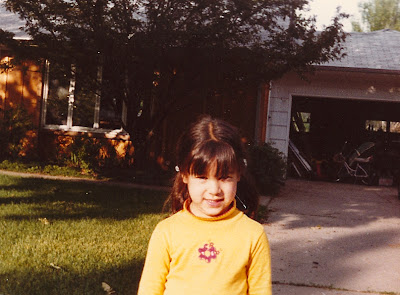
I was born and raised in Bloomington, Minnesota, a second-ring suburb of Minneapolis. My parents lived in the same house for 33 years... a 1950's "starter home" in a neighborhood with other young families and kids my age.
I was born in 1976. My parents used to take us out camping, with an occasional canoe trip. At home, we mowed the lawn and raked the leaves, and sometimes a neighbor stopped in for a cup of coffee. I felt safe, and loved.


This was "Barb"-- I was Barbara Burkhart until 9th grade, when my dog died, I started high school, got contact lenses, braces, a perm, and changed my name to Malia-- my middle name. In a way, I buried her -- Barb -- as I've buried so many things I didn't like about my past. I wanted to be from someplace else. "Malia" felt more exotic, suggested that I was more interesting than I actually was. It made me feel less "white", less ordinary, less bumbly and certainly less nerdy. "B" is a silly letter. It makes your lips bump out. It belongs to floppy awkward things like bananas, boobs, ballerinas. (Ballerinas, in that they make me feel floppy and awkward)

In so many ways I had the "American Dream" childhood. And yet, like so many other now-grown kids who were raised in the 'burbs, I had it all but felt something important was missing. Something "real", that I pictured kids who were raised tough in the inner city, or the freedom and wildness I imagined country kids had. My parents were lower-to-middle middle class. Plenty of classmates had the latest toy or Guess jeans that my family couldn't afford. My mom was constantly bargain-hunting, and we saved money whenever we could, for our college education. And so much of what I was taught, how I was raised, was how I could go out and get a suburban house of my own someday-- to gain the education that would provide a job, which would earn enough to pay a mortgage on, raise 2 kids, and save for their college. To invest in a retirement fund, for some security in my old age.
To me, the suburbs have never felt like a "place" unto themselves... and the soul-sacrifice involved with attaining it has never seemed worth the cost. Maybe I'll regret it, when I'm 65 and retired, or barely scraping by in my middle age-- but somehow I've always known this was not the life I wanted.

I've been skipping around the question ever since graduating from college-- where to settle? I lived in a small town, Northfield, for 4 years... I lived in the inner city of Chicago for 6 months, then in Osaka, Japan-- one of the biggest cities in the world-- for a year. I kept Minneapolis as a home-base, and took off on world travels for months at a time. Now I'm honing in on strategies to make a move out to the country, and begin a rural arts center. To live in a community where I can raise a kid to run free and wild. My retirement plan is to live where I know my food comes from my neighbors, my water is from that well, and I can finally slow down enough to listen.
Instead of dating on short camping trips, we could move in together, nature and I, and grow old --

Is it a crazy dream?
I don't know, but I feel I have to at least try,
to find out what dream may be on the other side...


(And yes, I know
all these dreams
education, confidence,
so much of who I've been and
who I've become
is a gift
of privilege...
having grandparents
who worked hard
to send my parents
to school
so they could work hard, too,
and I could have this choice.

I appreciate the gift,
and,
I am also working hard
to pass it along)

Saturday, August 4, 2007

This is the place we once were,


Life is a run-on sentence.

There are no absolute stops, no silence that is perfect.

The snow, done being snow,

scratches and rubs
against itself, internally,
makes a sound
as it melts
and the dirt makes the way

for that cool sip of water

Even death is not complete,
For from the moment
my last breath
enters the air
I have already begun
the gradual descent

returning


Who will take on my pieces?
That last breath was inhaled
by the flowers at my side
who didn't know
they, too, were dying

Cut off from the root


(On Gutting a Fish)
A strange transformation went over me, as I grasped the fish firmly in my capable hands. Out of its element, I am the master, the decider. Before it bit the hook, we were an equal match, it and I... It swims too fast for me to snatch. A fish any slower would've been eaten extinct by now. A fish might have once kept its population healthy and strong, had I been an ancient human stabbing at it with my stick. I would practice throwing and angle, and the fish would practice narrow evasions and quickness.

But the fish has had less of a chance to adapt to our new invention, the hook.
Then the net.
Then the sonar-sonic depth sensors and high-speed fishing boats.

The ocean's life will never die,
but it is poorer...
Lines of the myths
from the ocean's ancestors

forgotten,
without an heir
to pass it onto,
which is what extinction is, really.


There seem to be plenty of sunnies in this lake.

I went along with killing the fish.
They were planning on eating it,
and just like that,
this scaly, gasping creature
in my hands was now a food-source, a task.
After its last breaths,
I would work
(Like the worms will later do on me)
on converting this body into food.

We're never that many steps above dirt, really

In the cycles of what we do every day.

With every poop, every pee


and everything we eat.
How much more time we'd have
if we could just lay face down and eat dirt directly.

Chlorophyll really is the best trick ever.

All us Zoological Beings
are still playing catch-up
to that incredible feat.

The only way we survive, really,

is by capitalizing on their labor.

A bunch of Chlorophyll slaves

whose bodies I eat for dinner.


mmm.
Eat your Vegetables~!


Saturday, July 21, 2007

Labor Pains


I have little to add.
All I can do is pay witness
to the effort of this small life
in its pains to birth itself

and we?
having eaten all we can handle
as greedy and obese
and as bent on attending
to our own inner workings

I can't help but see
the way he folds his hands
curled around his face
quivers and shakes
with what seems like
prayer.

What if every obese person in the world right now
Each one of us carrying too much weight, excess baggage
were to suddenly hang ourselves upside down
engage in meditation
and solemnly strain
to split our skins


Can you imagine
the trust involved in this whole process?
To willingly sleep, knowing you'll be visited by a dream
that will change you forever,
No promises,
No guarantees,
No recourse to sue should anything go wrong.

Nothing to go on but an instinct.

Instinct.
Yes, I'm back on that track again.
I still find it mind-boggling that every other creature on the planet, right down to its smallest insects and even single-celled organisms, has been given instructions on how to live. They carry out their lives faithfully and following a healthy code of genetic variance to expand diversity and that species' chances.

And I feel somewhat cheated, that my species, or my culture at any rate, lost its code. Is this what being booted out of the garden is all about? That we know longer seem to be able to fit into any natural system without destroying a fragile balance-- eventually rendering it unsuitable even for ourselves.

We are able to peer into nature piece by piece, whether by electrode microscopes or Hubble telescopes. Great and small, there are distinctive patterns that infuse everything. All seems based on certain unalienable codes, that are far more comprehensive than our bill of unalienable rights. Un Alien Able. Alien. Outsider. From another planet? Another star? Even those stars seem to be dancing the same dance-- swirls and sworls seem as our own breath exhales on a frosty night. Even Aliens, I suspect, aren't immune to the same rules.


A Stab at Naming (or inventing) a Few of These Codes: (If I were a science major these might be more accurate, but it's 12:26am and I'm in the mood to brainstorm:)

1) Diversity is a result of stability. A song has a chance to play itself out with exponentially greater variations, with increasingly more time given to compose.

2) Big changes that happen fast interrupt the song; many don't make it. Due to diversity, some do. That song is remembered and passed on. As the change becomes old news, the songs left over have a chance to rework and begin the process again. (ie. Mammoths and Giant Sloths went extinct in the ice age, but other species sprang up since then)


3) The easier the conditions of survival (and if successful adaptations were made) the more songs get started. More freedom is taken. There is a tendency to get artistic, more creative, more daring in shapes and forms and absurd specializations. (ie. red i'iwi birds in Hawaii that can only sip nectar from one certain tubular flower. Or the zillions of dragonfly bodies, each one shimmering in its own unique armor.)


4) Creativity is vital to survival. Monocultures may be more efficient, but in the end, are tremendously more fragile. Without creativity, potentially species-saving innovations are impossible.

5) The essential difference between humans and animals seems to be our efforts at cultivation: of food, yes, but more significantly, we cultivate our own cultures. In the absence of memory of our instinctual codes, we write our own codes -- Or, in most cases, a cultural code is handed over to us, and we follow it.

6) Certain individuals in any culture will tend to challenge and rebel against the established "codes". Most often these individuals are young, who are still able to sense what the weaknesses are-- and haven't yet gotten "used to it." They are the most sensitive, more apt to believe that things can still be improved.
Youth are more wild. They are less domesticated, and are more in tune with their instincts. Even if they can't articulate or fully understand WHY things seem wrong, a general sense of dissatisfaction, anger, and rebelliousness pervades our youth culture.

7) Oldness seems to = resignation. After a certain age, it seems people more or less wish things could have stayed the same. Adaption becomes increasingly more difficult. It takes too much energy to learn the world anew. Oldness, however, can be more a matter of perspective than of physical years on the planet. If their adaption muscles have been adequately exercised, many elders retain their mental flexibility.


8) Children, and certain artists seem to intuitively understand that reality is what we make it. They view themselves as self-appointed masters of their own universes. Children and artists spend a considerable amount of time playing, discovering, inventing and testing.


9) Play, creativity, and paying attention to our youth are essential components to keeping culture healthy and attuned to itself.


Within my parents' lifetimes, a man was sent up to the moon for the first time. And now, most people seem to think it's impossible that we can create a way to live, sustainably, right here on earth.

Do we have so little faith in our own ingenuity?

Right now, (by my observations and in generalization), we have a culture which:

Monocrops our food
Monocrops our cultures (stomping our diversity and pressing for assimilation-- sameness of thought--, I think largely through tools of religion and pop culture)
Marginalizes youth, artists, and free thinkers in general

Who do we let be the authors of our culture?
Who do you choose as your "culture authority"?
When was the last time you really played?
When did you begin to be less curious about testing the world out for yourself, and begin accepting things the way they are?
Do you think of yourself as a cultural leader, follower, or just someone doing their own thing?

...Oh, yes, two last observations:

10) the cultures that have survived the longest seem to retain the memory, passed down from generation to generation, to respect the land and take care of it. Perhaps in their millenia of evolution, they are the survivors of a near wipe-out, and what remains of the lesson learned is a hard-wired value.

and,
11) It seems likely that the only way out of this is not marketplace driven or even legislation, but the birth of a new cultural code-- to re-wire the value of land stewardship into our most essential values. If the heart is in place, will the neccessary inventiveness follow?
To make these changes stick is going to take a whole lot of creativity, and the power of our youth.

Sunday, July 1, 2007

About the videos "Briefcase Sweetheart" and "Wild America"

Check out the latest 2 video installments!
(Click on the images in the right-hand column)
"Briefcase Sweetheart" and "Wild America"

"Briefcase Sweetheart" is a much different approach to dancing in space. Whereas the other explorations have been improvised (Butoh is, for the most part, an improvised art)-- this one I worked over a few times to polish it up. I got some very strange looks from people hiking past, along the north shore of Lake Superior's Temperance River State Park. Why a business suit? I wanted the surreal juxtaposition, like Rene Magritte's suited figures raining down from the sky.

Sometimes I feel like an alien when I go out to a wild place. I can't seem to leave my city life truly behind me, and so I take it along. It tags along like an uninvited sweetheart... I'm so wrapped up in my relationship to this metaphorical briefcase that I never seem to fully arrive in "nature" before it's time to go back to the city again.

Inside the briefcase is a sheet of white paper. For summer work right now, I am teaching landscape painting to kids. Something interesting happens when I draw or paint things: I enter more deeply into it, looking close-- admiring subtle details that might have escaped my notice. Shadows and light, color and form. And yet, as I paint, I begin to feel more and more distant from what I'm painting. I am so focused on capturing this image for later, that I become totally unaware of my body, of my physical comfort, and block out awareness of anything else happening around me. So I simultaneously become hyper-sensitive and deadened to perception. Strange.

And afterwards, the place I was in, the multi-dimensional place and moment becomes, suddenly, an object.... The painting still exists to record this meeting, of artist and place... but it is framed. It is reduced. It has been made so much less real than it was. And what makes this place so special, that I should spend so much effort in remembering it? Is my living room at home any less special?

(music for "Briefcase Sweetheart" is from Pieces of Africa by Kronos Quartet)
-----------------------------------------------------------------------------------------------------------------
"Wild America" video ... Science & Spirit

Ever since I was a kid, I would battle with my sister over the remote control for the TV-- She'd want to watch the Monkees. Me, Marty Stouffer's "Wild America." I used to dream about becoming a naturalist, getting to interact with all kinds of creatures and witnessing all that cool stuff I'd see on TV. Well, now I get the chance to be my own Nature Show host.

I'm interested in exploring and making apparent some of the general ways I interact with nature-- as an introduction to this performance as a whole. In my "Wild America Show" I approach nature as a know-it-all guide... and as a deeply Spiritual Nature Guru.

How do science and spirit intersect?

In the scientific view, nature is broken down into understandable parts. Patterns we don't understand are labeled as "random." Wendell Berry in his book of essays Home Economics writes about the discoveries of fractals, and how science is continuing to discover patterns where the category "random" was once applied. Berry states that the dismissal of patterns we don't yet understand as "random" denies the existence of mystery. The possibility that we are a part of a pattern much more vast than we'll ever be able to break down or comprehend.

Berry's essay pretty well summarizes my concept of God, or Mystery. In my view, "Intelligent Design" as a concept doesn't necessarily have to be at odds with the concept of evolution. Why have such a limited view of what "God" is?
What if God is a verb, and not a noun? If God exists in the patterns through which all things cycle? In any case, it's clear that our tampering with natural systems is having severe repercussions on a scale more grand and more minute than we could ever know. Havoc is being wreaked on entire watershed systems, and inside the flow of blood within our own bodies. Is it time, yet, for humans to acknowledge that there are aeons of accumulated wisdom stored in the DNA of every being-- when allowed the freedom to express itself and live its life as it was meant?


What are the negative effects on ourselves, our own psyches, to the extent that we've "tamed" our own instincts? Ever observe how creatures in a zoo, while perhaps in fine physical health, exhibit some form of mental neurosis? What is the essential difference between creatures that are inherently wild and untameable, versus those which are considered "domesticable"? Why would any creature submit itself to another being, against the better judgment of its own instinct?

In nature, most systems are self-righting -- that is, they heal themselves over time. If I cut my skin, the sore scabs over, new skin grows beneath it, and a few weeks later the spot is totally healed. Likewise, cities are only kept nature-free through intensive maintenance. If we stopped repairing the cracks in the roads, how long would it take the grass to reclaim the pavement? It seems like the natural inclination of the universe is to heal itself. To reclaim the wisdom of its systems.

Why not assume that we humans, too, are capable of regaining balance by simply re-orienting ourselves to our "God-Given" directions? How different a human would I be, were I to stop reinforcing this facade of "separateness", and allow for the natural wisdom of my body? For example, my natural inclination is not to kill anyone in Iraq. Even if I had the means, I simply wouldn't do it. Is it possible that the systems we're currently enmeshed in are only capable of such extreme imbalance through unnatural enforcement? And if the people decided to stop feeding energy into the maintenance of this?

How many soldiers return from war with psychological damage?

Is it because, deep inside, they violated their own nature?

In any case, my version of "Wild America" is a tongue-in-cheek portrayal of myself approaching nature (as I often do) in an idealized, romantic way. And yet, the ending sequence, of dancing on the rocks, takes place at a location I've felt a connection to "the Divine" in the past. I realize that I am in constant search of those moments-- felt so rarely. The fading in and out of the video-- my dancing body billowing in and out of time with the music, "Hide and Seek" (by imogen heap), captures what it feels like to return there, to those rocks. I've had a long history of returning again and again to this place. Ghosts of past me's brush shoulders with the present. Like the clouds, I drift in and out of being.

The first time I came to this place was 8 years ago.
If the cells in my body completely recycle themselves every 7 years,
then all the bits that were once me, who came here, have now moved on into being something else.

So then why do I remember it?

(additional music in this video by sigur ros -- the "meditation & bugs" sequence)
------------------------------------------------------